
A Telegram bot can answer a command in a short demo and still be unready for real users. Production readiness depends on the less visible work: protecting the bot token, choosing a reliable update-delivery method, validating requests, preventing duplicate processing, limiting logs, handling failures, and giving one person responsibility for rollback.
This checklist gives a small software team a practical path from first prototype to a controlled deployment. It uses Telegram’s current developer documentation as the source of truth and treats every production action as a separate, reviewable decision.
Define one useful outcome before building commands
Start with one customer or team outcome. A bot might return an approved status, accept a structured request, notify an operator, or guide a user to the right support path. Write the outcome in plain language and define what the bot must not do.
List the minimum inputs, the expected answer, the source of that answer, and the human owner for exceptions. Do not begin with a long command list. A smaller complete workflow is easier to test, monitor, disable, and explain.
Mark sensitive or state-changing requests before implementation. Billing, account access, credentials, personal data, security events, and irreversible actions need stronger authorization and usually a human decision.
Register the bot through the official path
Telegram’s official introduction for developers directs developers to BotFather to register a bot and receive its authentication token. Treat that token like a password. Anyone with it can act through the bot’s API access.
Store the token in an approved secret store or deployment environment, not in source control, screenshots, chat messages, issue trackers, or client-side code. Give it only to the runtime and operators that need it. Document how to replace it if exposure is suspected.
Use separate bot identities or credentials for development and production when the operating model permits it. A test should not accidentally reach real users or production data.
Review the current API contract
The Bot API changes over time, so verify methods, fields, limits, and release notes against the official manual before deploying. A current guide to telegram bots api can help organize BotFather setup, tokens, links, update handling, webhooks, security, and deployment checks in one place.
Pin the library or SDK version used by the project and record the Bot API behavior it expects. When an API update arrives, test compatibility in isolation before changing the production runtime.
Avoid copying an old code sample without reviewing its authentication, error handling, and update model. A working response does not prove the sample is secure or maintainable.
Choose one update-delivery model
Telegram supports long polling with getUpdates and push delivery with setWebhook. The official webhook guide explains that webhooks send updates to an HTTPS endpoint, while long polling asks for updates. Choose one model for each deployed bot and document why it fits the runtime.
Long polling can simplify a controlled worker deployment, but the team must manage offsets, restart behavior, duplicate protection, and runtime availability. Webhooks can deliver updates quickly, but the public endpoint, TLS, request validation, capacity, and error behavior become part of the production surface.
Do not let two workers process the same update stream without an explicit coordination design. Duplicate side effects are more expensive than duplicate logs.
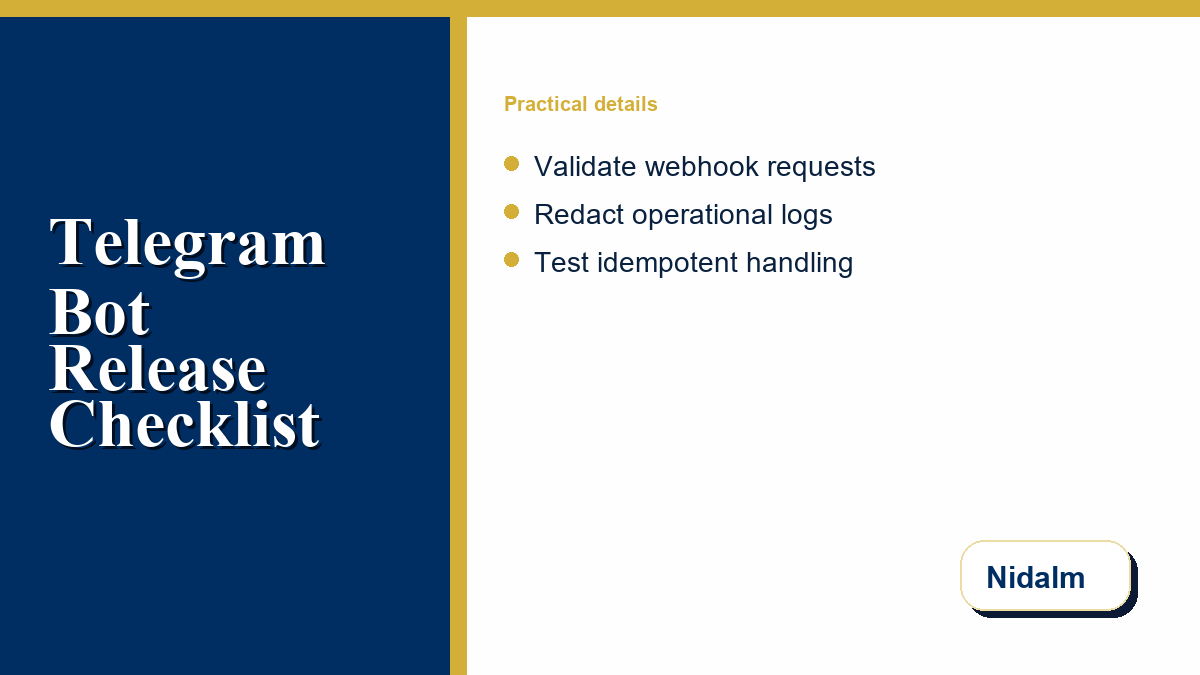
Secure the webhook boundary
A webhook endpoint should accept only the expected method and content type, enforce a request-size limit, validate the update shape, and return a controlled response. Do not expose stack traces, tokens, database details, or internal paths in error messages.
The Bot API manual supports a webhook secret_token that Telegram sends in the X-Telegram-Bot-Api-Secret-Token header. Validate the expected value with a timing-safe comparison where available, and reject missing or mismatched values before processing the update.
Use HTTPS with a valid configuration and keep the endpoint path difficult to guess. Review Telegram’s current supported webhook requirements before deployment because network ranges and platform behavior may change.
Make update processing idempotent
Retries and duplicate deliveries are normal failure cases in distributed systems. Record the Telegram update identifier or a derived operation key before applying a state-changing action. Replaying the same operation should return the stored result or a safe no-op rather than applying the action twice.
Separate parsing, validation, decision logic, and side effects. A malformed update should fail before any write. A valid update that cannot complete should leave a clear retry or rollback state.
Test duplicate commands, delayed updates, out-of-order messages, worker restarts, timeouts after a write, and a response failure after successful processing. The evidence should show what changed and what did not.
Keep logs useful and private
Operational logs should answer when an update arrived, which safe code handled it, how long it took, and whether it succeeded, retried, or escalated. They should not become a second database of private conversation content.
Redact tokens, authorization headers, webhook secrets, contact details, message text that is not needed for diagnosis, and raw provider responses. Use one-way hashes or bounded identifiers when the team only needs to correlate events.
Define retention and access before launch. Limit who can view production logs and record how to delete diagnostic data when it is no longer needed.
Design the human handoff
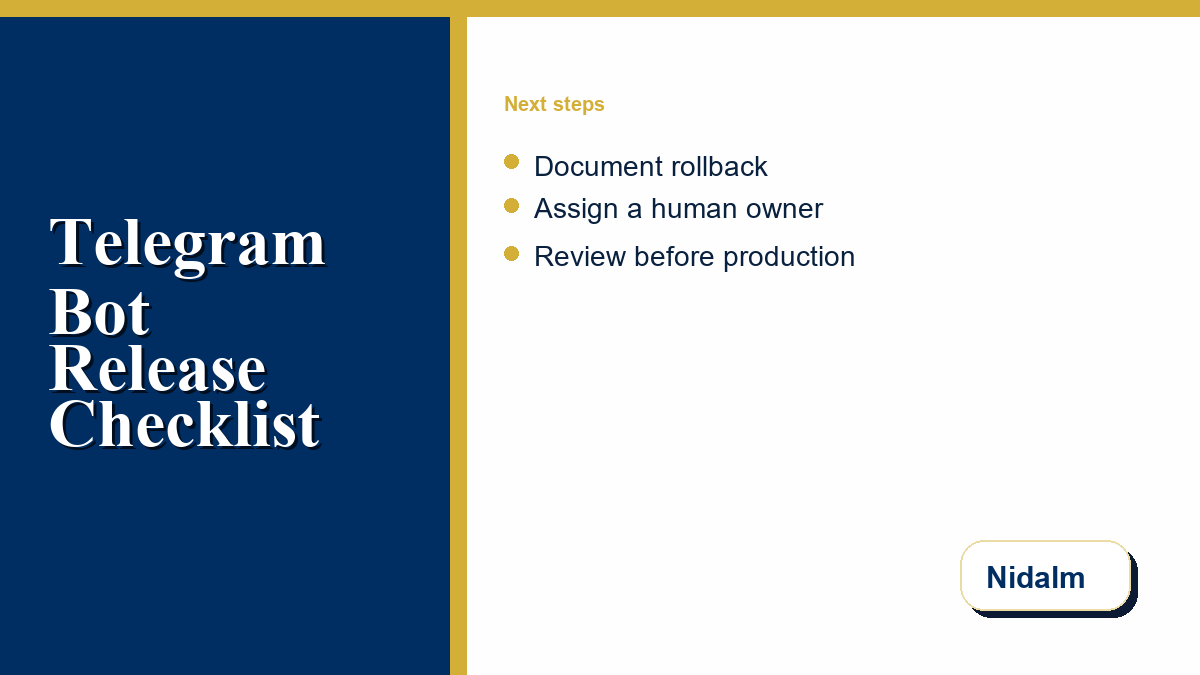
A bot needs a clear stopping rule. Unsupported requests, low-confidence answers, account or payment issues, privacy and security concerns, legal or safety questions, abusive behavior, and state-changing actions should route to an accountable person.
The handoff should preserve only the context needed to continue: the user’s reviewed request, the safe result already provided, and the reason for escalation. Do not force the user to repeat the entire exchange, but do not copy unnecessary private history into a ticket.
Nidalm’s guide to getting more value from an AI investment offers a useful planning principle: technology should serve a defined operating result. Its overview of bounded AI writer use cases also illustrates why a narrow, reviewed use case is easier to manage than an undefined promise.
Build a staging acceptance matrix
| Gate | Test | Required evidence |
|---|---|---|
| Identity | Development and production bots are distinct | Reviewed bot username and environment binding |
| Token | No token appears in code, logs, or screenshots | Secret scan and rotation runbook |
| Updates | Only one delivery model is active | Webhook or polling configuration readback |
| Validation | Malformed and unauthorized requests fail closed | Blocked-request tests |
| Replay | The same update produces no second side effect | Idempotency test and state hash |
| Handoff | Sensitive requests reach a person | Escalation test |
| Rollback | The bot can be disabled without data loss | Tested disable and restore steps |
Plan rollback before production
Document how to stop update delivery, disable the worker, restore the previous build, rotate the token, and verify that no duplicate processor remains active. Keep commands scoped to the exact bot and environment.
Capture a pre-deployment snapshot of configuration hashes, version, runtime state, and expected external endpoints without storing secrets. Define the public and internal health checks that must pass after deployment.
Set a rollback trigger before the change: repeated failures, unexpected message delivery, rising duplicate counts, authorization errors, privacy leakage, or an inability to prove which version is running.
Launch with an operator-controlled window
Begin with fixture updates and an isolated bot. Move to a limited operator-controlled test only after token handling, request validation, replay behavior, logs, handoff, and rollback all pass.
Record the exact approval scope: bot identity, environment, build fingerprint, test command, expected result, and expiration. One approval should not silently authorize future deployments or unrelated messages.
After the window, disable test-only flags, remove temporary data, verify the final bot and webhook state, and review public behavior. Do not count a successful API call as proof that the complete user workflow is safe.
Frequently asked questions
Should a small team use long polling or webhooks?
Choose the model that fits the runtime and operations. Long polling needs offset and worker control; webhooks need a secure public HTTPS endpoint and request validation.
Where should the bot token be stored?
Use an approved secret store or deployment environment. Never put the token in source control, client-side code, screenshots, or general logs.
How can a webhook request be validated?
Use Telegram’s current webhook secret-token mechanism, validate the expected header before processing, and keep the endpoint protected by HTTPS and strict input checks.
Why must update processing be idempotent?
Retries and duplicates can occur. Idempotency prevents the same update from applying a state-changing action more than once.
What should trigger human review?
Escalate unsupported, low-confidence, account, billing, security, privacy, legal, safety, abuse, and state-changing requests to an accountable person.